
Model assembly#
torch_ecg models are assembled bottom-up from registered building blocks. This page explains the layering, the registries that connect the layers, the static shape-inference contract every model honors, and the two output conventions present in the codebase.
The layering#
Building-block configs —
torch_ecg.model_configsholds ready-madeCFGobjects for every backbone family (resnet,mobilenet_v1/v2/v3,vgg16,densenet,multi_scopic,xception,regnet, plus theTransformerattention block and classifier/RNN heads), grouped so a full model config such asECG_CRNN_CONFIGis just a few references to block configs.Backbones — feature extractors registered in the
BACKBONESregistry; any of them can serve as thecnnof a task model without modifying the task model’s code.Task models — the top level in the
MODELSregistry (ECG_CRNN,ECG_UNET, …); they own the input/output contract (leads, signal length, classes) and combine a backbone, attention and head into one serializable unit.
Registries#
Registries are the package’s extension points — a name-to-class map
with a uniform build(name, **kwargs) entry point:
Registry |
Contents |
|---|---|
|
task models / feature-extraction backbones |
|
attention blocks ( |
|
assembled by name from |
|
criterion classes (assembled from |
|
preprocessing / online augmentation transforms |
Registering a custom backbone requires only a decorator
(@BACKBONES.register()); the
User Guide shows a worked example.
The compute_output_shape contract#
Every model and backbone implements
compute_output_shape(seq_len, batch_size=None), which returns the
output shape without running a forward pass. This makes model
composition verifiable at construction time: a task model obtains
the feature shape from its backbone in order to size its head, and a
configuration can be checked without executing it:
from torch_ecg.models import ECG_CRNN
from torch_ecg.model_configs import ECG_CRNN_CONFIG

model = ECG_CRNN(classes=["AF", "I-AVB", "LBBB", "Normal"], n_leads=12,
                 config=ECG_CRNN_CONFIG)
model.compute_output_shape(2000)     # (None, 4)
The classification head globally pools over time, so the logits shape
is (batch, n_classes) regardless of input length.
Outputs: tensors and output dataclasses#
The classic task models, such as ECG_CRNN, return plain
logit tensors. Newer code — the
benchmarks
being the reference — wraps model outputs in typed dataclasses from
torch_ecg.components.outputs
(ClassificationOutput,
MultiLabelClassificationOutput,
WaveDelineationOutput,
RPeaksDetectionOutput, …): fields carry explicit names
(logits, bin_pred, pred_classes, …), the objects
support + for batching and remain plain
CFG dicts underneath, so checkpoints and
logging keep working. When writing a new task model, prefer the
dataclass contract.
System design#
The overall workflow of the package — data files flow through readers, preprocessing and augmentation into tensors, which feed the trainer driving the model, while the config file drives model construction and checkpoints enable resuming:
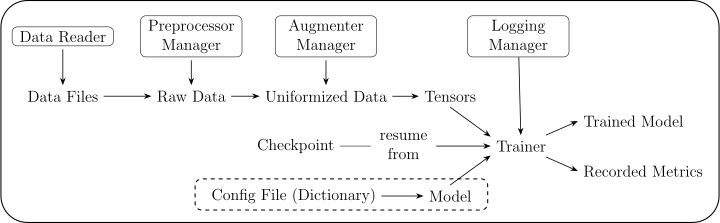
Main Modules and Work Flow.